The New Gold Standard: Why Your Business Needs Blockchain-Secured CRM Data

In an era where data is often referred to as the new oil, the way we handle customer information defines the longevity of a brand. Traditional Customer Relationship Management (CRM) systems have served us well for decades, acting as the central nervous system for sales, marketing, and support. However, as cyber threats become more sophisticated and consumer privacy regulations tighten, the cracks in conventional centralized databases are beginning to show. Enter the world of blockchain-secured CRM data—a revolutionary shift that promises to restore trust, enhance security, and redefine the customer experience.
The Problem with the Status Quo



To understand why we need blockchain, we first have to look at the vulnerabilities of current systems. Most CRM platforms rely on a centralized server architecture. This means there is a single point of failure. If a hacker manages to breach the central database, they gain access to everything: names, addresses, purchase histories, and sometimes even sensitive financial data. Beyond external threats, centralized systems are also prone to internal data manipulation and accidental deletions, which can lead to a lack of ‘data integrity.’ When your sales team and your marketing team see different versions of the same customer profile, the friction begins to erode the bottom line.
Enter Blockchain: More Than Just Cryptocurrency
While many people associate blockchain exclusively with Bitcoin, the underlying technology is a versatile tool for data management. At its core, a blockchain is a decentralized, distributed ledger that records transactions across many computers. Once a piece of data is recorded, it cannot be altered retroactively without the alteration of all subsequent blocks. This ‘immutability’ is the secret sauce that makes blockchain-secured CRM data so compelling.
By integrating blockchain into CRM workflows, businesses can create a transparent and tamper-proof record of every interaction a customer has with the brand. It’s not just about security; it’s about creating a single source of truth that every department can trust implicitly.
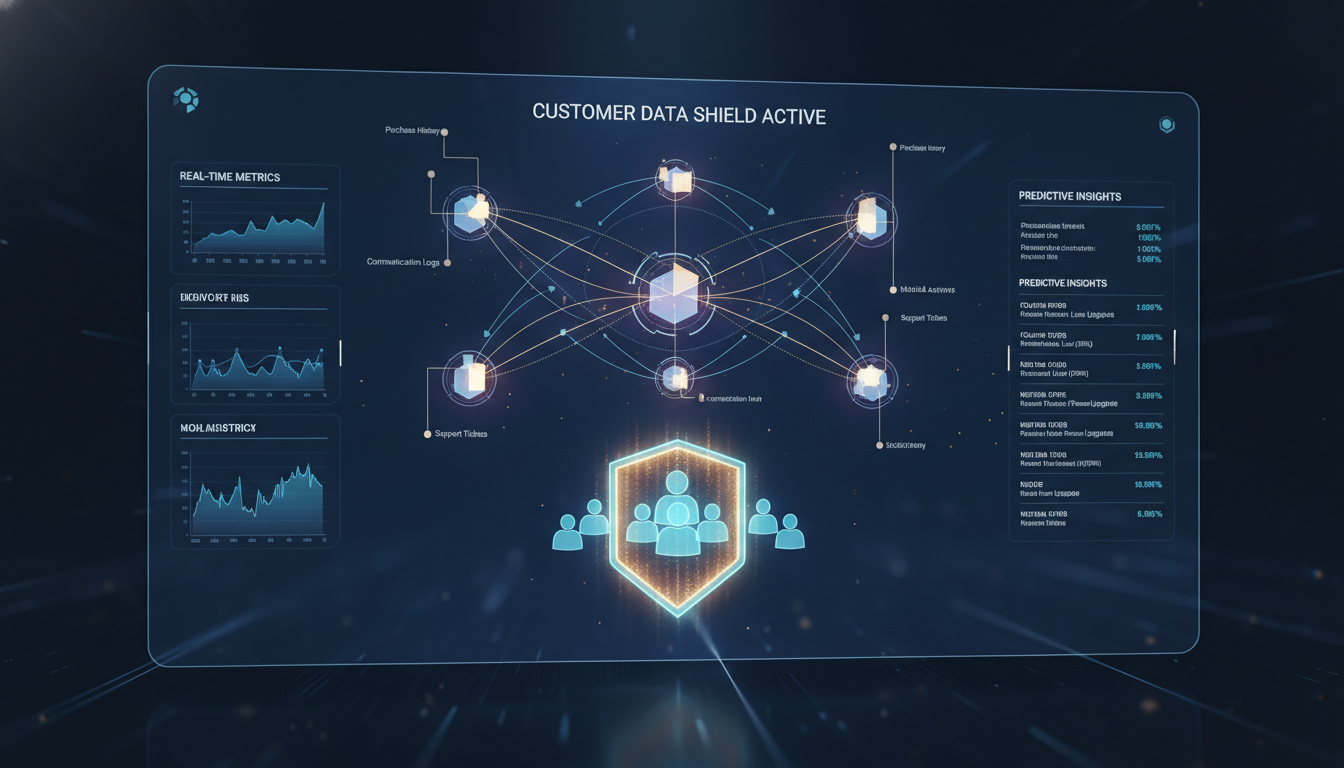
[IMAGE_PROMPT: A futuristic digital interface showing a secure blockchain network connecting various customer data points with glowing shields and locks in a clean, minimalist blue and white aesthetic.]
The Key Benefits of Blockchain-Secured CRM
#
1. Unrivaled Data Security and Privacy
With blockchain, data is encrypted and distributed across a network. This makes it exponentially harder for hackers to compromise the system. Furthermore, blockchain allows for ‘Zero-Knowledge Proofs,’ a cryptographic method where one party can prove to another that a statement is true without revealing any information beyond the validity of the statement itself. In CRM terms, this means you can verify a customer’s eligibility for a promotion without ever having to ‘see’ or store their sensitive personal documents.
#
2. Enhanced Data Integrity and Accuracy
Duplicate records and outdated information are the banes of a CRM manager’s existence. Blockchain ensures that every update to a customer profile is timestamped and verified by the network. This eliminates the ‘silo’ effect, where different departments hold conflicting information. Everyone from the warehouse manager to the social media intern sees the exact same, accurate data.
#
3. True Data Ownership for Customers
We are moving toward a ‘Web3’ world where consumers want to own their data. Blockchain-secured CRM allows for a ‘decentralized identity.’ Instead of the company ‘owning’ the customer’s data, the customer holds the key to their own data block and grants the company temporary access. This not only builds immense brand trust but also makes compliance with regulations like GDPR and CCPA much simpler, as the ‘right to be forgotten’ is built into the architecture of the data itself.
#
4. Streamlining Operations with Smart Contracts
Imagine a CRM that automatically triggers a loyalty reward the moment a customer’s purchase is verified on the blockchain, or a system that releases a refund instantly if a shipping milestone isn’t met. These are ‘Smart Contracts’—self-executing contracts with the terms of the agreement directly written into code. By layering smart contracts over CRM data, businesses can automate complex processes, reducing administrative overhead and human error.
[IMAGE_PROMPT: A professional business meeting in a modern glass office, where a dashboard displays transparent data analytics and interconnected nodes representing a blockchain-driven customer journey.]
The Challenges of Implementation
Of course, it’s not all sunshine and rainbows. Transitioning to a blockchain-secured CRM requires a significant shift in mindset and infrastructure. Currently, blockchain technology can face scalability issues; processing millions of CRM updates in real-time requires a very efficient network. There is also the ‘integration gap.’ Most legacy systems weren’t built to talk to a decentralized ledger. However, as ‘Blockchain-as-a-Service’ (BaaS) providers emerge, these hurdles are becoming lower every day.
The Human Element: Building Trust in a Digital Age
At the end of the day, CRM is about relationships. A relationship without trust is just a transaction. When a customer knows that their data is protected by the most advanced cryptographic technology available, they feel valued. They feel safe. That emotional security translates into brand loyalty.
In a relaxed business environment, we often talk about ‘transparency.’ Blockchain is the first technology that actually makes transparency a technical reality rather than just a marketing buzzword. By showing your customers that you take their data security seriously enough to decentralize it, you aren’t just protecting your database; you are protecting your reputation.
The Road Ahead
As we look to the future, the convergence of AI and blockchain-secured CRM data is where things get truly exciting. Imagine an AI that can analyze customer behavior with 100% accuracy because the data it is feeding on is verified and untampered. We are looking at a future where marketing isn’t just ‘personalized’—it’s ‘personal.’
In conclusion, while the adoption of blockchain in CRM is still in its relatively early stages, the benefits are too significant to ignore. For the forward-thinking business leader, the question is no longer ‘if’ blockchain will secure our data, but ‘when.’ By starting to explore these technologies now, you are positioning your company at the forefront of the next great digital evolution. It’s time to move beyond the central server and embrace the decentralized future. Your customers, and your IT department, will thank you.